©copyright Raggydax, 2026
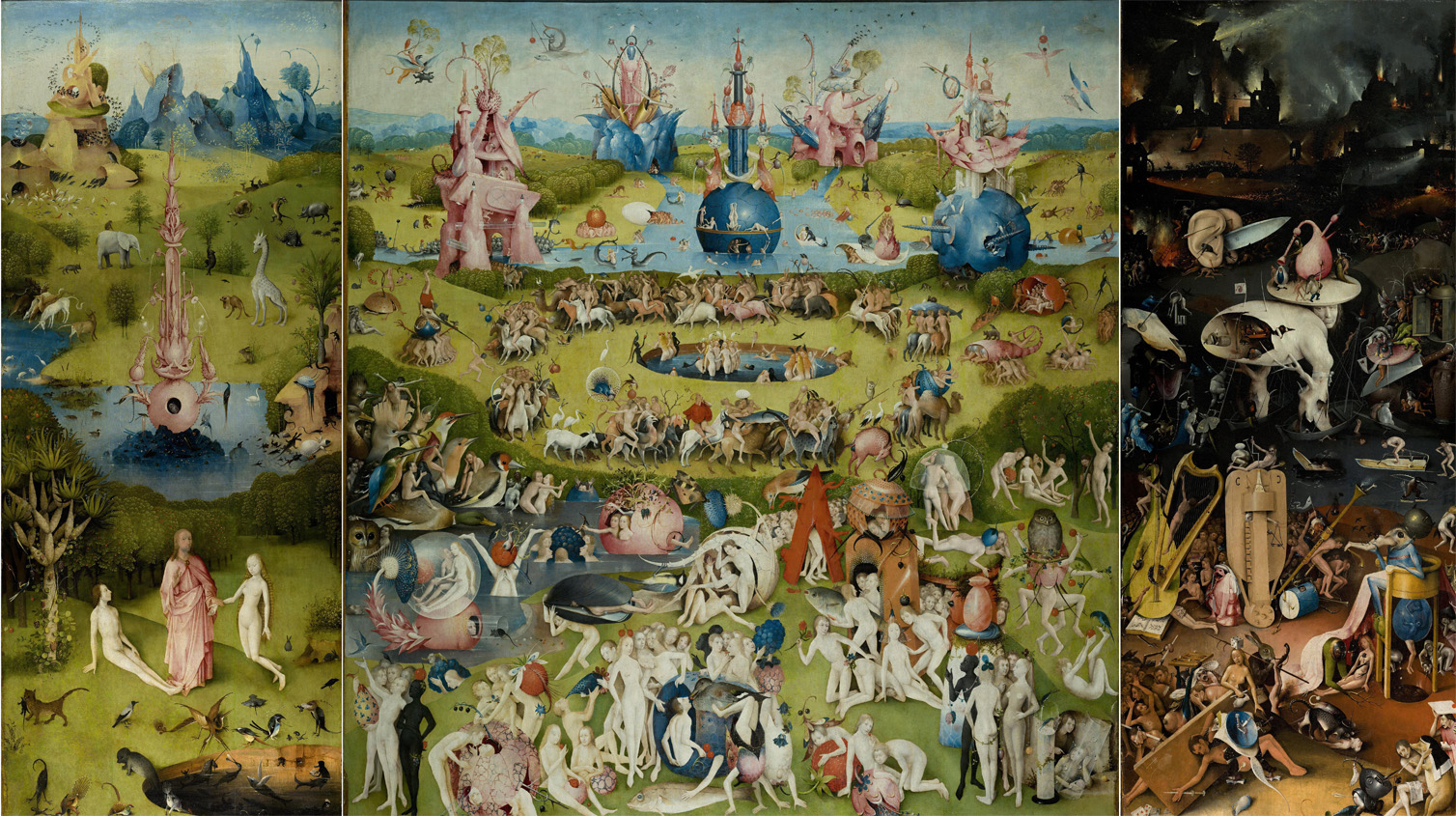 Garden of Earthly Delights; Hieronymous Bosch 1490-1510
Next chapter in sequence
Preface:
We ripen, like fruit. Over the years our minds unavoidably drift to when the fruit will drop to rot on the ground to disclose its fertilised seed. A reason for writing this book is my own imminent dropping off the branch. Raising a dominant question, “What then?” This question of two words propels - will and has – much of the artifices of this world and all preceding it.
Humanity collectively is like a tribe of feral children inhabiting the wild. The virus of religion, like a nurturing parent who, after the need for sustenance is satisfied, instructs that we play nice with others. Religion created the environment in which civilisation could flourish. “I’m going to tell your Father if you don’t behave,” is the scolding from the nurturer in a household where the children are unruly. God the Father is invoked and the children quieten. Why?
For fear. The fear of the consequences of rule breaking. The fear of punishment.
The rules are set out clearly – engraved in stone and they’re easy to follow for most civilised people, boiled down to a core of five. Five which govern behaviour as it affects others. (Killing, stealing, lying, covetting and adultery). Then to ensure the survival of the credo another five rules are tacked on safeguarding the religion, any religion. (Things like obedience to the rules,no other rules before the rules and reverence for those who came up with the rules, that is to say the authors.)
When religion dies disorder follows in which the laws of the feral world prevail.
Fear distils down to two types of fear; physical or mental. Physical fear is characterised by things like food insecurity, physical safety, sexual rejection, instinctive fear for the wellbeing of offspring and all of the consequences suffered through the repudiation of the first five rules. The mental fear is of the Big Black after dying.
Back to the first question, when will the dropping of one’s ripened life, death to be less metaphorical, happen? Followed by ‘what then’? Those who believe in the “you only live once” headspace are the profane. They who allow themselves the indulgences of the body, the sating of all urges such as gluttony in all its forms and psychopathy in all its manifest behaviours, are feral. Their actions are inhibited only by self-interest and the penalties for rule-breaking. They view through a profoundly reductionist lens in order to justify actions in relativist terms. The world they see is a world governed by deterministic process reduced to four dimensions on a linear plane. Consequence follows cause. They accept atomic structure and chemical relationship which generates all the effects their eyes behold. To them there is nothing after death. Therefore no such thing as the soul. We, according to that thesis are completely and utterly subjects of appetite.
Trust is a miraculous intangible, which can evolve between entities. A lubricant which allows exchange, the polar opposite of seizure.
Then there are those who believe in the science of consequences, who are squarely inside the tent of religion. Whatever its designation. For them understanding consequences of the actions of a life lived is confined to the binary of penalty and reward for one’s soul after death. Assessing that ledger motivates the investment of energy in the actions undertaken which is of itself a profoundly selfish motivation. Notwithstanding the good resulting for others in good deeds the balance sheet depends heavily on faith, on the trust the individual invests in the credo. A religion is most easily comprehended by its personification in some symbolic individual. A Christ, a Moses, a Buddha, a Mohammed, a Confucius, a Zarathustra, a Guru Nanak, a Bȁb and others. All of whom exemplify a code of behaviour and thought to which subscribing assures preservation and elevation of the soul. The individual’s soul. To believe this as an alternative to the Big Black is faith. Trust is the reason for received truth. Without trust faith is impossible.
Doing right for the pay off in the afterlife has led to some of the worst abominations in human experience. All fuelled by the fear of death and its consequent judgement by some divine magistracy.
Every individual is a total epigenetic imprint, a memory of that individual from their most protean form to their present. Nihilism, deliberate or ignorant, is choosing denial instead of acceptance of this legacy. Actions to satisfy expectation of a comfortable afterlife relies on the narrow perspective of this life. It is drifting in ambiguous phenomena. An opening to evil by justification. Truth may be plumbed in entering the Before-life. In truth trust can grow. Without trust there are only transactions. In transactions without love there is no Humanity. What are we without Humanity?
Augustine, retirement text.